
AI is best suited to processes that recur often, are based on solid digital data, involve many manual, rule-based steps and have a clearly visible benefit. It is less suited to tasks that call for a lot of creativity, intuition or a delicate touch. If you assess your processes systematically before your first AI project, you invest where it pays off.
Why shouldn’t every process become an AI project?
Getting started with AI rarely fails because of the technology. It fails because of the choice of use cases. If you pick a process for which there is hardly any data, or one that runs differently every time, the prototype stays a prototype. Good candidates, on the other hand, quickly show what AI can do in everyday work, and they build support for the next steps.
How do you recognise good AI candidates?
Processes with high potential share four characteristics:
- Data: the data is solid, available in digital form and of good quality.
- Process: the workflow is standardised, recurs frequently and involves many manual, rule-based tasks.
- Value: the potential to cut costs, increase efficiency or improve quality is obvious.
- Complexity: the process is manageable both technically and organisationally, and proven solutions are often already on the market.
On top of that, the risks should be clear and manageable, for example with regard to data protection or the consequences of a wrong decision.
Which processes are typical candidates?
- Order intake: orders arrive by email or as PDFs in all kinds of formats and are currently entered into the ERP by hand.
- Invoice verification: incoming invoices are read, matched against the purchase order and the delivery and submitted for approval.
- Customer enquiries: emails and tickets are understood, prioritised and routed to the right place.
- Reporting: recurring reports are compiled from different sources and annotated.
What they have in common: many similar cases, clear rules and a noticeable amount of time that people spend on them today.
When should you leave AI alone (for now)?
- The data is missing: there is hardly any historical data, it only exists on paper or it is incomplete.
- The process is not standardised: every department does it differently, and exceptions are the rule.
- Creativity and intuition come first: for example in negotiations, strategic decisions or creative concept work.
- Mistakes would be costly and hard to spot: without control mechanisms, the risk is too high.
Such processes are not ruled out for good. It often makes sense to lay the groundwork first, by standardising workflows and digitising data, and then to reassess the process.
How do you assess your processes systematically?
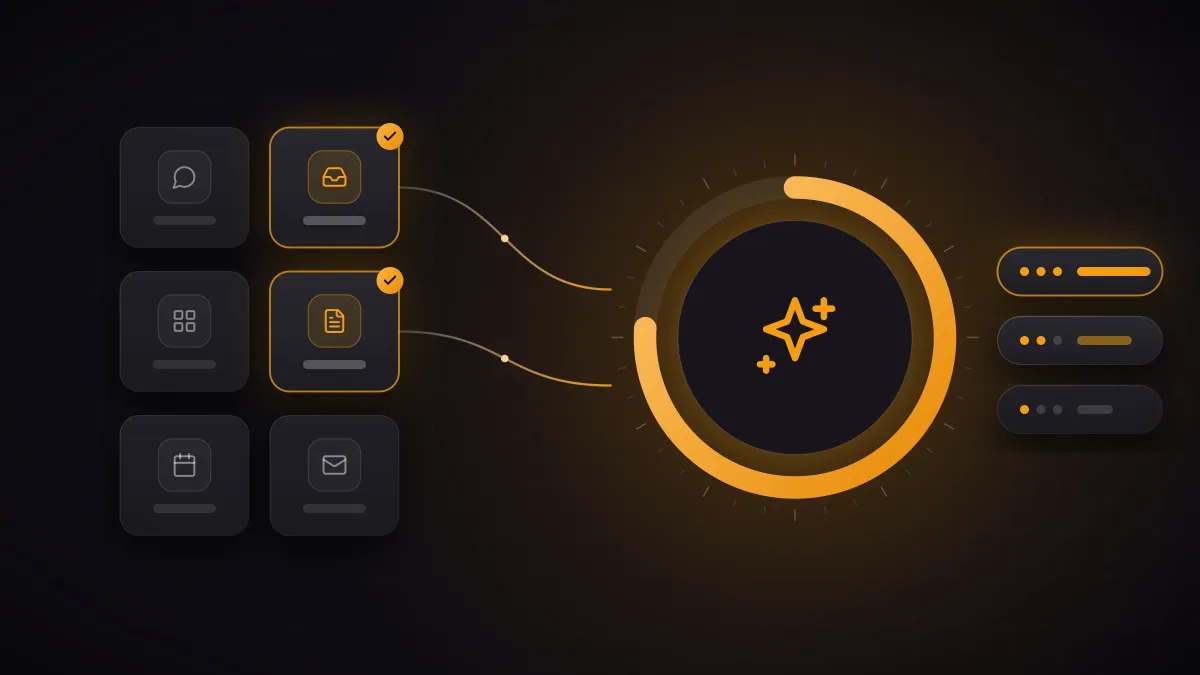
Our AI check gives you a first impression: ten questions about one process, evaluated directly in your browser. The pre-AI assessment goes deeper. We assess your processes against 30 criteria in five categories, each scored from 0 to 3 points. Processes with 61 to 90 points go to the top of your AI roadmap, those with 31 to 60 points are prepared for it first, and processes with 30 points or fewer are deliberately put on hold.
What happens after the assessment?
The high-potential candidates move on to a business case, formal risk acceptance and a pilot project with real data. How a use case becomes a solution in production is shown on our AI integration & automation page.
Frequently asked questions
Do we need large amounts of data for AI? It depends on the use case. For extracting information from documents, modern language models often work without any training of your own. Forecasts, on the other hand, need a sufficiently long data history.
Can we do the assessment ourselves? For a first impression, yes, with the AI check. For a reliable roadmap, we recommend the pre-AI assessment, in which we assess your processes together with you.
What happens to processes that are not suitable (yet)? They are deliberately put on hold. It often makes sense to digitise the data or standardise the workflows first and then to reassess the process.
Would you like to know where AI can make the biggest difference in your company? Get in touch.